- The Association’s covenants define specific requirements summarized below. If this document conflicts with the covenants, the covenants have control.
- All fencing plans need to be submitted and approved by the Board prior to installation using the ACR form found on the website. This includes plans for new fences, “major repairs”, and modification of existing approved fences.
- All fences, except at the development entrance, must be of wood materials.
- Fence related applications must include the following information as part of the ACR Form submission:
- An accurate drawing (sketch) of your Lot, including where the fence will be located relative to property lines, location of home, sidewalks, street, driveway and other applicable structures. Setbacks from the sidewalk need to be clearly marked with distance. Fences within the city right of way will not be approved. Applicants must warrant that the fence as designed and built complies or will comply with all existing local government requirements applicable to such fences.
- The fence’s length and height dimensions, including the location and size of all gates.
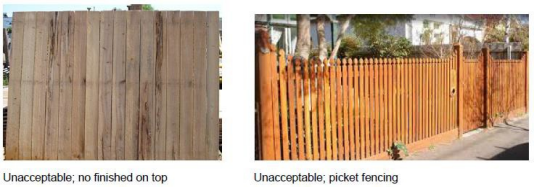
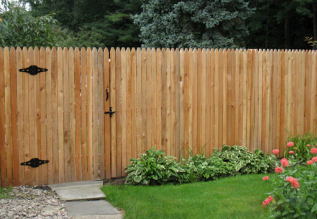
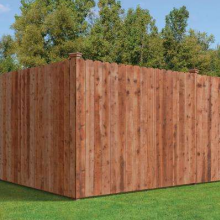
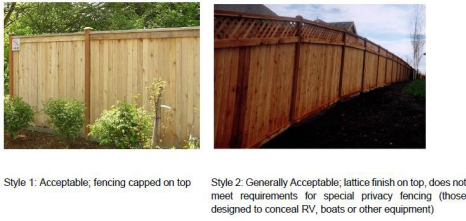
- The style of fence – Examples Below
- Proposed dates for the start and completion of the work.
- Contractor contact information, including all insurance information. Or a statement of self-work and self-insurance.
- Approval Process
- Owners must submit the plans to management prior to starting the project and (in accordance with the Enforcement paragraph detailed in section 12) allow 30 days for the initial review.
- The Board will review the submitted plans, may ask for additional or clarifying information, and may require changes to the submitted plans. (Applicants may request a variance to any HHCO requirement which may be granted at the board’s discretion)
- Management will issue approval of the plan by email. Any plan not receiving an approval 60 days after its initial submission shall be deemed denied.
- The fencing plan will be filed with and retained by the Association.
- Once an approved fence is built, repaired, or altered the Board shall review the fence as-built to confirm the work was completed according to the approved plan.
- Minimum Materials and Construction Specifications:
- Posts must be #2 or better pressure treated to minimize warping and spaced no more than 8 feet apart and should be symmetrical.
- Posts must be a minimum of 4”x4” and cemented into the ground at least 20 inches deep
- Cement must not be visible and needs to be covered with at least 3 inches of soil
- Rails must either be #2 or better pressure treated or #2 or better western red cedar
- Fence slats must be constructed from #2 or better western red cedar
- Fences must have cap rails – please see allowable fence styles below
- Fences that exceed 16 feet in length and are adjacent to the sidewalk require a shrub or tree be planted between the sidewalk and the fence at a minimum of 10 feet apart and no less than 6 feet from the end of the fence.
- All gates should follow the same style as the fence installed. Hinges must be concealed to the inside of the gate. Decorative elements or styles are allowed with approval. Please include details in your fencing plan submission.
- All stain colors need to be approved by the Board. The entire fence needs to be stained (front and back); no partial staining allowed. Fences are not required to be stained. Owners may choose to let their cedar fence weather naturally.
- Note: as of 2020, the ACC is no longer approving paint, solid stains, or any coating that primarily sits on top of the wood surface. New fences will require transparent or semi-transparent stain. These products have proven to weather more naturally and be easier for owners to maintain, resulting in a higher degree of uniformity throughout the neighborhood.
- Maintenance and Repairs:
- Fences and gates shall be kept in good physical and visual condition and in harmony with the subdivision. The Lot with the fence shall be responsible for ongoing maintenance. The HHCO will inspect fences to ensure proper maintenance; fines may be imposed for violations. Recommend re-staining after the first 2 years and then every 3-5 years to maintain life of the fence.
- Any repair of more than one post, more than re-staining, replacing existing hardware on one gate, or more than five fence slats shall be deemed a “major repair.” The Association has the authority to require the removal of any fence-related work performed without approval.
- “Major Repairs” shall be submitted within 30 days of being identified. Once approved, the “Major Repairs” must be completed within 60 days.
- Special Privacy Fencing Requirement
- Special screening fences (those that are designed to conceal boats, RV’s, equipment, etc.) must be based on the standard 6 ft. capped-rail style fence but may be topped with a trellis for growing plants/vines. The trellis must be used to grow natural plants/vines and must create a solid visual barrier to fully conceal the vehicles behind it. (Lattice tops are not acceptable for screening because they do not create a solid barrier to fully conceal a recreational vehicle from plain view.)
- One large gate, up to a 12 ft. opening that allows for vehicle access, is permitted provided the gate is supported, does not sag and lacks any sizable gap between gate bottom and ground. These larger gates may need to have a steel frame system for support.
- As with all fencing projects, a detailed plan and Architectural Change Form must be submitted and approved by the board of directors prior to starting the work.
- Existing Unapproved Fences
- Existing unapproved fences shall fall into one of two categories:
- Unapproved and not conforming with municipal requirements
- Unapproved existing fences that meet current municipal requirements will be subject to the approval process when the fence is replaced, altered, or subject to a material repair.
- Merely unapproved.
- Unapproved and not conforming with municipal requirements
- The HHCO may require the remediation of the fence to current HHCO design standards for all unapproved existing fences. However, if an existing unapproved fence is in violation of current applicable municipal requirements, then the HHCO shall require the fence to be remediated to conform with the current municipal requirements and with the current HHCO requirements.
- Existing unapproved fences shall fall into one of two categories:
- Other Notes:
- Open rail fencing may be used,with approval, adjacent to greenbelts, gulches, or other open space tracts. Fencing in front of the home is prohibited.
- A variance from the above guidelines and requirements may be requested and granted on a case by case basis where consideration is given to balancing the property owner rights and the overall aesthetics of the neighborhood.
Typically Accepted Styles:
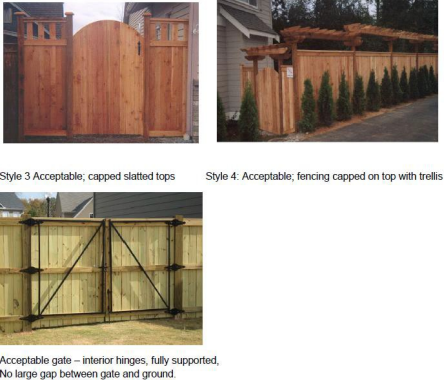
Unacceptable styles: